четверг, 25 октября 2018 г.

Rare blue asteroid-comet reveals itself during fly-by

Blue asteroids are rare, and blue comets are almost unheard of. An international team led by Teddy Kareta, a graduate student at the University of Arizona's Lunar and Planetary Laboratory, investigated (3200) Phaethon, a bizarre asteroid that sometimes behaves like a comet, and found it even more enigmatic than previously thought. The research team's results will be presented during a press conference on Oct. 23 at the 50th annual meeting of the American Astronomical Society's Division for Planetary Sciences in Knoxville, Tennessee. Using telescopes in Hawaii and Arizona, the team studied sunlight reflected off Phaethon, which is known to be blue in color. Blue asteroids, which reflect more light in the blue part of the spectrum, make up only a fraction of all known asteroids. A majority of asteroids are dull grey to red, depending on the type of material on their surface. Phaethon sets itself apart for two reasons: it appears to be one of the "bluest" of similarly colored asteroids or comets in the solar system; and its orbit takes it so close to the Sun that its surface heats up to about 800 degrees Celsius (1,500 degrees Fahrenheit), hot enough to melt aluminum. Astronomers have been intrigued by Phaethon for other reasons, too. It has the qualities of both an asteroid and a comet based on its appearance and behavior. Phaethon always appears as a dot in the sky, like thousands of other asteroids, and not as a fuzzy blob with a tail, like a comet. But Phaethon is the source of the annual Geminid meteor shower, easily seen in early to mid-December.


Meteor showers occur when Earth passes through the trail of dust left behind on a comet's orbit. When they occur and where they appear to originate from depends on how the comet's orbit is oriented with respect to the Earth. Phaethon is thought to be the "parent body" of the Geminid meteor shower because its orbit is very similar to the orbit of the Geminid meteors.

Until Phaeton was discovered in 1983, scientists linked all known meteor showers to active comets and not asteroids.

"At the time, the assumption was that Phaethon probably was a dead, burnt-out comet," said Kareta, "but comets are typically red in color, and not blue. So, even though Phaeton's highly eccentric orbit should scream 'dead comet,' it's hard to say whether Phaethon is more like an asteroid or more like a dead comet."

Phaethon also releases a tiny dust tail when it gets closest to the Sun in a process that is thought to be similar to a dry riverbed cracking in the afternoon heat. This kind of activity has only been seen on two objects in the entire solar system - Phaeton and one other, similar object that appears to blur the line traditionally thought to set comets and asteroids apart.

The team obtained several new insights about Phaethon after analyzing data obtained from NASA's Infrared Telescope Facility on Mauna Kea in Hawaii and the Tillinghast telescope, operated by the Smithsonian Astrophysical Observatory on Mount Hopkins in Arizona. They think Phaethon might be related or have broken off from (2) Pallas, a large blue asteroid farther out in the solar system.

"Interestingly, we found Phaethon to be even darker than had been previously observed, about half as reflective as Pallas," Kareta said. "This makes it more difficult to say how Phaethon and Pallas are related."

The team also observed that Phaethon's blue color is the same on all parts of its surface, which indicates it has been cooked evenly by the Sun in the recent past.

The team is now conducting observations of 2005 UD, another small blue asteroid astronomers think is related to Phaethon, to see if they share the same rare properties. This and follow-up work will help to untangle the mystery of what Phaethon is really like.

вторник, 23 октября 2018 г.

FEFU astrophysicist contributed into international-team efforts on study Comet 29P

Evgenij Zubko of Far Eastern Federal University (FEFU) in collaboration with other international team members has developed a comprehensive model to explain the results of a photometric study of the Comet Schwassmann-Wachmann 1 (29P) which was successfully accomplished recently. The findings came as a real surprise revealed that the dust environment of 29P predominantly consists of only one type of material - magnesium-rich silicate particles with presumably a small amount of iron (Fe-Mg silicates). The observation of Comet 29P - the so-called Centaur object - was carried out in the course of the Comet activity when the brightness of the celestial body increases for hundreds of times. This was resulting from sudden and barely understood outburst activity of the comet. The observation results published in Icarus journal. "We analyzed the scattering of light by particles of irregular shape in the inner coma of the 29P. To do so, we performed simultaneous modeling of the color measured in pairs of filters B-R and R-I. The model of light scattering, built on the basis of this computation, helped us to draw a conclusion about the chemical composition of cometary dust. Comparing the value of the imaginary part of refractive index with what is already known from laboratory studies of various analogs of cometary dust, we end up with a very much confident conclusion that the dust environment of this comet is almost one hundred percent is formed of particles consisting of magnesium-rich silicates with a small impurity of iron (Fe).


The volume of other possible impurities is extremely minor. What is truly significant it is that this type of material was detected in comets by the space probes. Furthermore, the retrieved size distribution of dust particles in 29P also appears in excellent accordance with in situ studies. Thus, we have drawn a very much self-consistent picture of the Comets." - reported Evgenij Zubko, a lead research scientist at the FEFU School of Natural Sciences.

Except for 29P, there is the only sole example of a comet with a single-component dust coma - this is the comet 17P/Holmes. Like 29P, Holmes periodically experiences outbursts presumably as a result of the inner CO and CO2 outgassing.

To perform the 29P study scientists measured the color of the sunlight reflected from its coma, using broadband filters adjusted to blue (B), green (V), red (R) and infrared (I) bands. Typically, such measurements undergo very little, mainly qualitative analysis, since quantitative analysis and retrievals of the microphysical properties of cometary species is a highly time-consuming problem. It should be based on comprehensive modeling of light scattering by cometary dust particles having various shapes, size distributions, and refractive indices. On the other hand, information about the color of comets is clearly insufficient for their classification.

The point is that with the same chemical composition that is described in terms of the refractive index, the color of a comet may vary significantly during a short time period due to temporary variations in the size distribution of cometary dust particles. Evgenij Zubko, says that this time the team made a breakthrough moving from contemplating the comet to retrieving chemical composition of its dust.

What emerged from the whole-team efforts is an important constraint on the chemical composition of the 29P coma. The findings surprised the scientists due to the fact that the dust environment of 29P consists of only one type of material. Two-component mixtures are more usual.

Astronomers have assigned comet 29P to a special class of objects, the so-called "Centaurs". The name of this kind of comets was given by analogy with the mythological creatures. Like centaurs, comets like 29P have a dual nature: being comets, they move in a nearly circular orbit, atypical for comets. Such orbits are usual for large asteroids and planets.

The 29P nearly circular orbit does favor its origin from the Kuiper Belt. At the same time, some data also indicate that the comet may origin from the Oort Cloud. This an extremely remote region is located at a distance of almost one hundred thousand astronomical units from the Sun - approximately one light year.

Comets that currently settle in the Oort Cloud are believed to have been thrown there in the early stages of the Solar System when it was only forming. They may spend in the Oort Cloud several billion years. Under the effect of various factors, such comets sometimes may return back into the inner part of the Solar System where the Earth is located.

Further study of the chemical composition of the 29P nucleus is aimed to determine more accurately which part of the Solar System the comet originates from.

Commenting on the importance of comets observation, Evgenij Zubko, emphasizes that comets are among the oldest objects in the Solar System. Some of them get formed when the Sun had not yet become a star, which means they should have very much primordial composition; whereas, billions of years spent by comets in very distant and cold Oort Cloud may help preserve their ancient composition. With comets we get a chance to have a look into the history of our Solar System. Currently, there are several known groups of comets with significantly different properties. Explaining of these differences is aimed to help scientists better understand how the Solar System evolved and which processes took place in it 4-5 billion years ago.

суббота, 20 октября 2018 г.

К Земле приближается зеленая комета

В декабре 2018 года рядом с нашей планетой всего в 11,5 миллиона километров пролетит комета 46P/Виртанена (46P/Wirtanen). Этот ледяной шар, размером больше километра станет «кометой года» – одним из десяти самых близких сближений комет с начала эпохи космических исследований с Землей. Виртанена представляет собой короткопериодическую комету с периодом всего в 5,4 года. Принадлежит к семейству Юпитера, кометы которого имеют расстояние афелия между 5 и 6 а. е. Была открыта 17 января 1948 года американским астрономом Карлом Виртаненом. Астроном Ясуси Аосима из Японии сделал представленный выше снимок кометы 46P/Wirtanen с помощью 12-дюймового телескопа. На изображении можно увидеть, что комету уже окутала зеленая кома. Зеленый цвет испарениям кометы придает двухатомный углерод (C2). Сейчас комета, которая находится вблизи орбиты Марса и выглядит как объект 10-й величины, то есть невооруженным взглядом её не увидеть, однако, по оценке астрономов, к декабрю 2018 года она станет ярче более чем в 200 раз в конечном итоге достичь величины +3.


Максимальное сближение с Землей состоится 16 декабря – нашу планету с небесной странницей будет разделять расстояние в 11,5 миллиона километров. По информации из блога Федора Шарова, комета будет перемещаться по созвездиям Печи, Кита, Эридана, снова Кита, Тельца, Персея, Возничего, Рыси, Большой Медведицы и Малого Льва.

суббота, 13 октября 2018 г.

Ученые рассказали о неожиданных находках на поверхности астероида

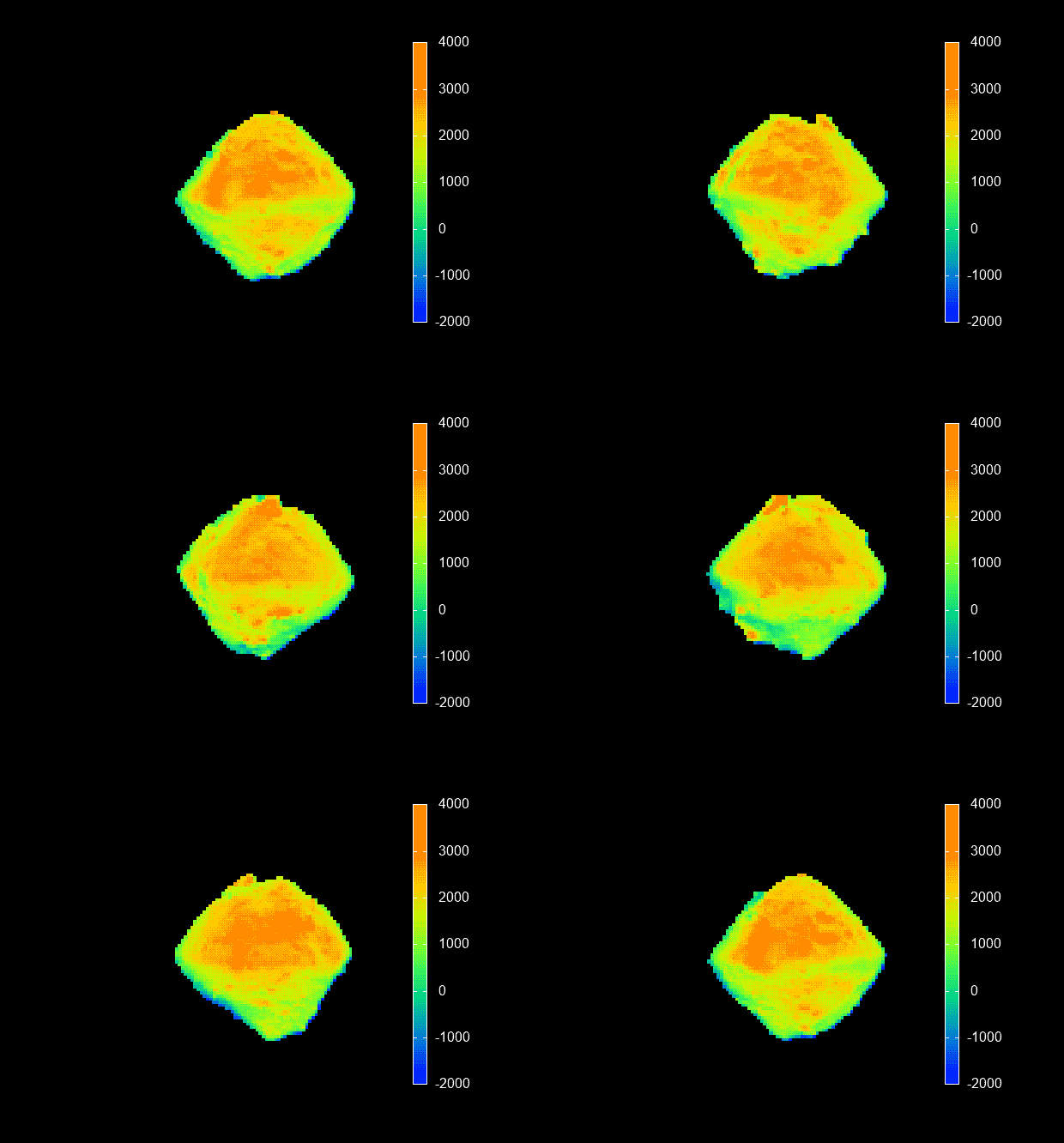
Первые данные и снимки с ровера MASCOT, севшего на поверхность астероида Рюгу на прошлой неделе, указывают не необычно малое количество пыли на этом небесном теле, причина чего пока остается загадкой для ученых. «Поверхность астероида оказалась еще более безумной, чем мы предполагали. Самым удивительным стало то, что мы не нашли крупных скоплений реголита, что, по идее, невозможно – космическая эрозия должна была породить большие количества пыли», — рассказывает Ральф Яуманн (Ralf Jaumann), научный руководитель миссии из Германского авиационно-космического центра (DLR). Автоматическая станция «Хаябуса-2» была запущена в космос в начале декабря 2014 года для изучения, забора и возврата проб с астероида Рюгу. Как надеются ученые, она вернет на землю первые 100% «чистые» образцы первичной материи Солнечной системы. Японский аппарат достиг цели в начале июня и начал длительную процедуру торможения и сближения с астероидом. Получив первые снимки и данные по устройству поверхности и недр Рюгу, зонд начал готовиться к процедуре по забору грунта. Помимо этого, «Хаябуса-2» доставила к астероиду три спускаемых аппарата – два японских ровера MINERVA-II1, аналоги которых были отправлены к астероиду Итокава вместе с «Хаябусой-1», а также европейский аппарат MASCOT. Роботы Rover-1A и Rover-1B были успешно сброшены на поверхность Рюгу в конце сентября.


Сложная процедура по высадке их европейского «кузена» началась в прошлый понедельник, а успешная посадка состоялась утром в среду. Как отметили в DLR, спуск MASCOT был идеальным с точки зрения пилотов миссии и ее научной «половины», что позволило роботу почти сразу начать исследования и установить связь с «Хаябусой-2».

Робот успешно решил все научные задачи миссии, собрав все необходимые данные и снимки для раскрытия тайн геологии Рюгу и изучения образцов первичной материи Солнечной системы. Потратив на это примерно одни астероидные «сутки», MASCOT проработал на поверхности астероида еще два дня, совершив несколько прыжков по его поверхности и собрав несколько дополнительных наборов данных.

Недавно «Хаябуса-2» закончила передачу данных, собранных ровером, и Яуманн и его команда начали изучение тайн астероида и историю странствий MASCOT по его поверхности. Уже сейчас, как отметили планетологи, можно говорить о том, они натолкнулись на массу новых и при этом крайне интересных загадок.


К примеру, во всех восьми точках, которых коснулся MASCOT во время своих прыжков по поверхности Рюгу, ученые нашли большое число гигантских кубообразных и просто угловатых блоков и булыжников, чьи размеры в некоторых случаях достигали около ста метров. Как они возникли и из чего они состоят – пока не понятно.

Вдобавок, ученые обнаружили, что плотность материи Рюгу была неожиданно низкой, заметно меньше, чем у аналогичных по составу метеоритов, так называемых углистых хондритов, которые периодически находят в Антарктике и в Австралии. Эти различия, как отмечает Яуманн, могут быть связаны как с разным происхождением Рюгу и этих «небесных камней», так и с тем, как материя астероидов меняется при падении на Землю.

Анализ всего массива данных, собранных MASCOT в разных точках на поверхности астероида, как надеются ученые, поможет раскрыть эти тайны и получить более полное представление о том, как была устроена первичная материя Солнечной системы.